
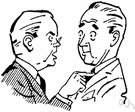
• Antagonists love to oppose others
• Antagonists seek out conflict for control and dominance
• Antagonists are likely to feel resistance to change
Have you ever had a meeting or a conversation with someone and left feeling overwhelmed, defeated and dominated? Perhaps you encountered an antagonist.
Antagonism is defined by behaviours of contending and opposing others. One who harbours this persona may believe their opinions and views to be superior and sadly, may even seek out opportunities to convey this due to enjoyment of control, competition and conflict. An antagonist’s unwillingness to compromise and ruthless self interest can be defining traits. This particular persona may enjoy attention, even if it is negative, and does not particularly care about being liked. Unfortunately, their objective understanding of communication and connection is compromised due to hindrances in early behavioural developments – usually trauma related.
You can see that this is almost the complete opposite to the people pleaser persona whereby hyper awareness towards how one is being perceived and anxiety about their likability factor are common streams of instruvie thought. This persona on the other hand feels traumatised by conflict and may sacrifice their needs (or even their own selves) to meet the demands of others.
Both of these extremes do not foster the space for meaningful relationships nor progression of one’s authentic self.
Both of these extremes are usually rooted in childhood traumas and insecurities.
The middle path would look like someone who invites challenges and conflict where it would benefit the couple/team and someone who holds space for other people’s opinions, equally valuing them as they would their own, to have truthful conversations, reach actual conflict resolutions or reach a healthy compromise.
Whilst both extremes do not foster the space for honesty, one who follows the middle path does, because their self esteem allows them to feel safe with sharing because they feel safe with others — even if others oppose their views or hold them accountable for mistakes. On the other hand, the people pleaser will see others as a threat to their safety and comfort and the antagonist will see others as resources or opportunities for more attention; sometimes even at others’ expense.
Research illustrates that people with antagonistic tendencies do not necessarily care to be liked, as mentioned above. Interestingly, this is also a trait of someone with high self esteem and also someone with high humility.
Somebody with high self esteem will not shy away from sharing their opinions even if they are controversial or unpopular because they have the self confidence to be able to regulate the emotions that come with hate or insults and so in that context, won’t care about another’s opinion so much. Somebody with humility may also exhibit this trait because sincerity demands that you do not share your opinions or work for self interest purposes, such as to attain attention or validation. And so in this context, especially when coupled with a spiritual lens, one may discount another’s opinion – particularly praises.
On the other hand, an antagonistic persona will not care for others’ opinions outside of acceptable or reasonable contexts. Individuals who harbour this persona are unreasonably difficult and moreover, usually insulting and rude, leading to unstable relationships and an accumulation of conflict. Whilst a self confident person and a humble person may discount opinions within reason, they will still be able to maintain care towards others’ feelings, approach relationships with sensitivity and would not feel excited by hate nor deem it as appropriate attention.
Unfortunately, the antagonist would and I think it is extremely important to be able to have this conversation in order to discern between these different characters. It can be confusing to understand who is safe to be around versus who isn’t.
We have all been there. Someone appears to be a certain way, humble and perhaps even holy. They may say all the right things to convey the appearance of humility and trustworthiness, but soon the mask falls off and a defeating arrogance and continual disappointment presents itself. You may make a thousand excuses in hopes that the person who you deemed fair and just in the beginning to reappear again. Unfortunately they most likely won’t, because it was not real.
For prevention reasons, a big sign to look out for is that their words do not come across genuine. It may seem like over the top humility or over the top confidence, sometimes, even over the top compliments/unnecessary flattery. This, accompanied by the extreme need to oppose, need for control and ruthless self interest are some of the key signs to look out for before investing yourself in a relationship or partnership which many have found themselves regretting and even recovering from.
An antagonist’s streams of thought usually lean towards, “I don’t want to change, I don’t need to change”, and to illustrate a subtler example for covert antagonism, “I am embarrassed by my behaviour but…” followed by repeated justifications, reasons and excuses, which actually, do not always make sense and are rather exhausting…but the passion, creative aggression and dominance may make it seem convincing. It isn’t hard to be captivated by an antagonist.
Research has shown that antagonistic personas do not care to change because of reinforcements of attention (even if negative) act as a supply for them. It is no doubt in my opinion that these traits are trauma responses that require sensitivity and appropriate professional attention. I believe such personas need and subconsciously thirst for deeper connections but are extremely protected by their egoic persona which acts as a defence mechanism. Compassion is definitely an ingredient that can break down these protective walls, however, in a manner which does not discount your needs and feelings.
Like narcissism, you get a spectrum with antagonistic people, and depending on how extreme these traits are, a person may be able to change promisingly the more they realise that connections and relationships can be safe and that over-protection is no longer necessary. One’s need for control and domanince may decrease the more one comes out of survival and learns how to become inter-dependent. They may even be able to develop empathy. However, because this is a serious long term self help journey and results are not always guaranteed because intention cannot be measured, nobody should have to feel responsible over another adult’s traumas in a relationship. If you do, you will often find your feelings and needs being sacfiriced until this becomes a habit which only exacerbates the antagonist’s oppressive traits.
***If you have been in the receiving end of such a persona and need help with recovery then feel free to reach out here for a 1:1 session. You can also contact samaritans.org for free support or your GP for longer term closer attention.
 Professional Female